

The Ceiling Detail Architects Keep Falling in Love With: Inside Apollo Service Troughs
Monolithic Ceilings ● Service Integration
May 4, 2026
This article explores why Apollo Service Troughs are becoming a defining detail in contemporary ceiling design, looking at how they allow architects to integrate lighting, sprinklers, HVAC and other services into a single refined architectural element. It covers the aesthetic and functional benefits of service integration, the role troughs play in preserving clean monolithic ceiling planes, and why designers are increasingly using them to simplify visual complexity without compromising accessibility, performance or flexibility.
PROJECTS LOOKBOOK ⇩Most ceilings fail for the same reason...
Not because the ceiling system itself is unsuccessful, but because everything forced into it slowly destroys the original architectural intent.
A perfectly resolved ceiling plane becomes interrupted by sprinklers. Diffusers. Speakers. Access panels. Emergency lighting. Sensors. Return air grilles. Before long, the ceiling stops feeling architectural at all. It becomes operational. Fragmented. Visually noisy.
This is precisely the problem Apollo Service Troughs were designed to solve. Not as an afterthought. Not as a coordination exercise hidden within services documentation. But as an architectural element in their own right.
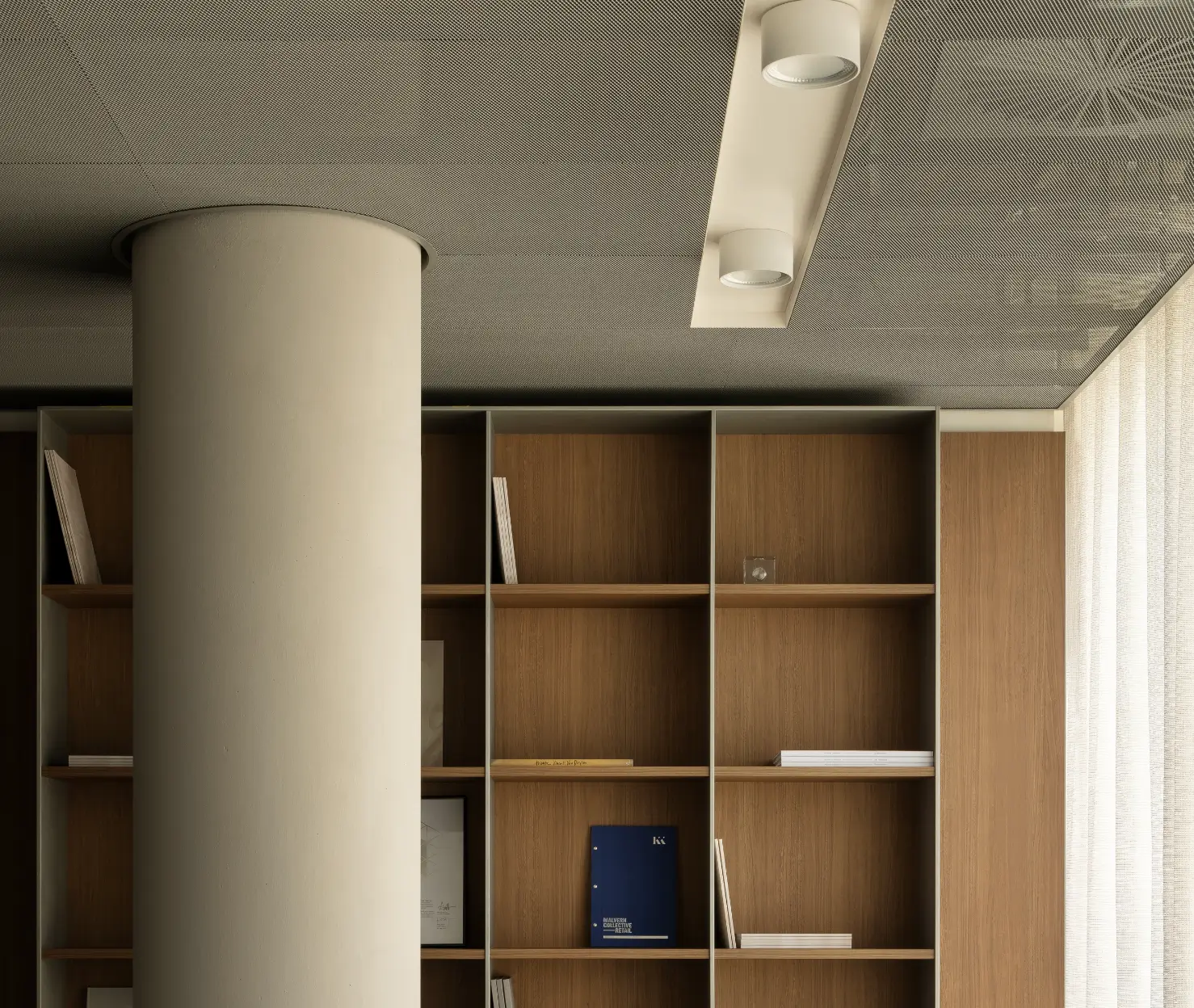
Apollo Service Troughs allow designers to consolidate services into a single clean linear expression, preserving the integrity of the ceiling plane while simplifying the visual complexity that typically accumulates overhead. The result is a ceiling that feels calmer, sharper and significantly more intentional.


The Architectural Value of Removing Visual Noise
Good ceiling design is often about restraint.
The fewer interruptions within a ceiling plane, the stronger the architecture tends to feel. Large uninterrupted surfaces create clarity. Rhythm becomes more legible. Spaces feel quieter visually, even in highly active environments.
The challenge is that buildings still need services.
Apollo Service Troughs resolve this tension by creating a dedicated linear zone capable of integrating multiple services within one continuous recessed architectural detail. Lighting, sprinklers, mechanical systems, speakers and access requirements can all be coordinated into a single trough rather than scattered across the ceiling indiscriminately.
This matters more than it sounds. Because once the visual clutter disappears, the ceiling itself begins reading as architecture again rather than infrastructure.
Monolithic Ceiling Planes Change How Spaces Feel
There’s a reason architects consistently pursue monolithic ceiling planes.
They create spatial calm.
Continuous surfaces allow materials, proportions and light to take precedence over technical clutter. In hospitality environments, workplaces, airports and civic projects, this contributes enormously to how refined a space feels.
Apollo Service Troughs are particularly effective because they allow ceilings to remain visually uninterrupted while still accommodating the practical realities of contemporary building services.
The trough effectively becomes an organised architectural spine running through the ceiling. Everything else disappears into it.
That level of integration dramatically changes the reading of the space.

Designed for Integration, Not Concealment
There’s an important distinction here.
Apollo Service Troughs are not simply about hiding services. They’re about integrating them intentionally.
That difference matters.
When services are poorly coordinated, ceilings often feel accidental. When they’re consolidated within a refined linear element, they become part of the architectural language itself.
Apollo Service Troughs are available in multiple profiles, including:
⦿ Compound Fold
⦿ Return Flange
⦿ Flush Mounted configurations
Each creates a slightly different visual outcome, allowing designers to control how pronounced — or restrained — the trough appears within the overall ceiling composition.
Some projects use the trough as a subtle incision within the ceiling plane. Others allow it to become a stronger linear design feature that reinforces circulation or spatial geometry.
Either approach works because the detail feels intentional rather than purely technical.

Airports, Workplaces and Large Public Projects
Service troughs become particularly valuable in projects where ceiling coordination complexity is high.
Airports are an obvious example.
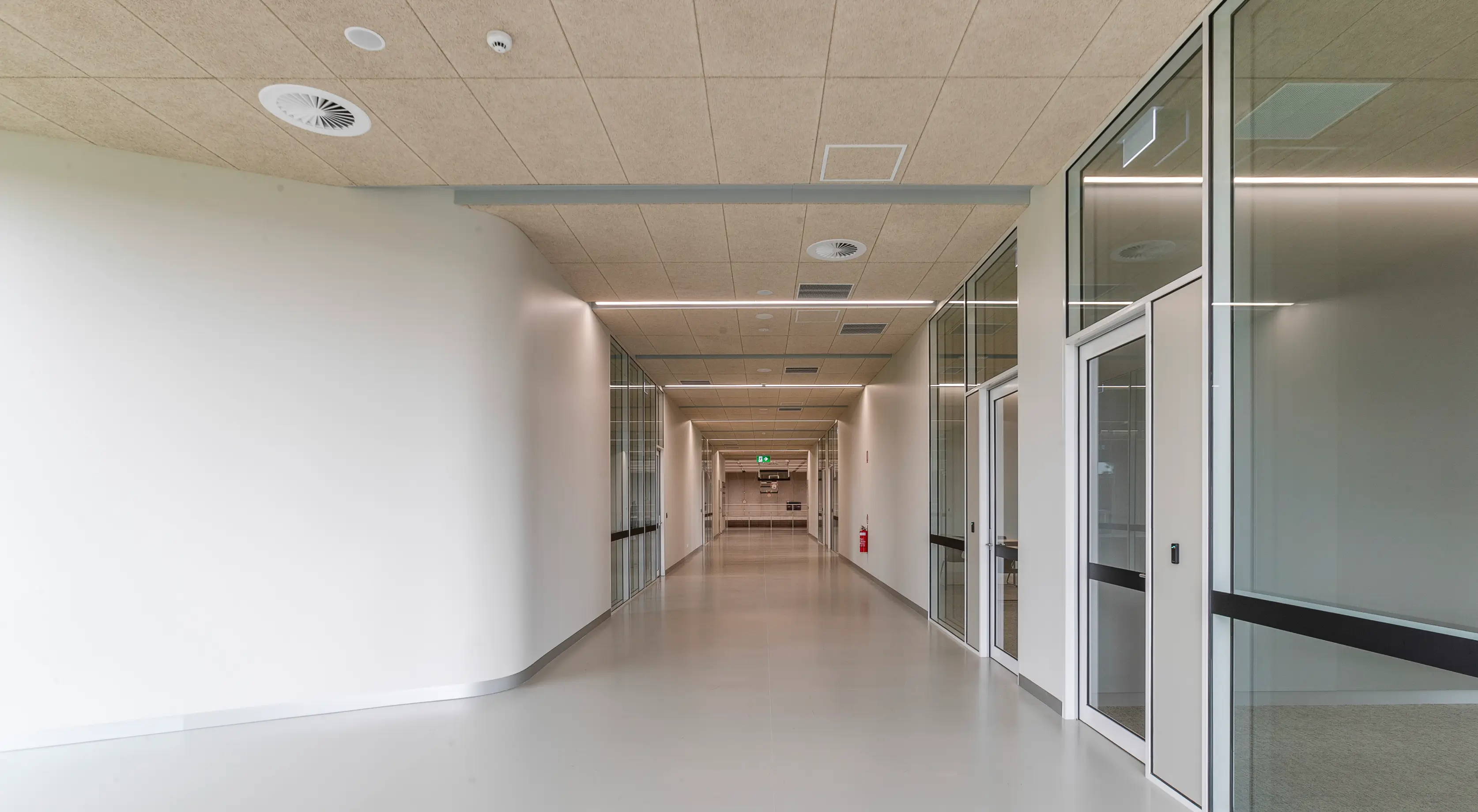
The Melbourne Airport T2 Arrivals project used a custom aluminium service trough to consolidate services and preserve uninterrupted ceiling planes throughout the terminal environment. The approach also improved long-term maintenance accessibility while supporting the project’s acoustic goals.
That project highlights something important about service troughs:
They’re not purely aesthetic devices. They also improve buildability, coordination and ongoing maintenance outcomes.
This becomes increasingly valuable across:
⦿ Commercial workplaces
⦿ Airports and transport hubs
⦿ Education projects
⦿ Hospitality environments
⦿ Civic and cultural buildings
⦿ Large public infrastructure projects
In these spaces, ceilings are often asked to perform at a very high level visually while also accommodating substantial services density.
Apollo Service Troughs help reconcile those competing demands.

The Relationship Between Lighting and Ceiling Design
Lighting is often where ceiling clutter begins.
Linear lighting systems, emergency fittings and diffusers can quickly overwhelm otherwise clean architectural ceilings if they’re treated independently. Service troughs allow lighting integration to feel coordinated rather than applied afterward.
The result is stronger ceiling rhythm, clearer alignment and more resolved spatial geometry.
Importantly, troughs also allow services to align with architecture rather than simply fitting wherever clearance permits.
That changes the entire reading of the ceiling composition.
Accessibility Without Sacrificing Design Integrity
One of the quieter strengths of Apollo Service Troughs is that they simplify future maintenance.
Services remain organised and accessible within a dedicated zone rather than dispersed unpredictably throughout the ceiling system. This improves long-term serviceability while reducing disruption to adjacent ceiling finishes during maintenance or upgrades.
That may sound operational, but it matters architecturally too. Because buildings rarely remain untouched after completion.
The easier a system is to maintain and adapt over time, the better chance the original design intent has of surviving long-term occupation.

Why Architects Are Increasingly Designing Around Services
Contemporary architecture is increasingly moving away from the idea that services should simply disappear.
Instead, designers are treating integration itself as part of the architecture.
Apollo Service Troughs align naturally with this thinking.
They acknowledge the reality of services while organising them into something controlled, refined and coherent. The ceiling remains elegant, but not unrealistically minimal. Functional requirements are resolved visibly and intelligently rather than awkwardly concealed.
That balance is what makes the detail so effective.
A Detail That Quietly Elevates Everything Around It
The best architectural details rarely demand attention. They simply make the space feel more resolved.
Apollo Service Troughs do exactly that.
─── They reduce clutter.
─── They simplify ceiling coordination.
─── They preserve monolithic ceiling planes.
─── They improve integration.
─── And they allow architecture to remain the dominant visual experience rather than the services infrastructure sitting inside it.
Which is ultimately why architects keep coming back to them.
At MBS Architectural, we work closely with architects, designers and contractors to develop Apollo Service Trough solutions that integrate seamlessly with broader ceiling systems and project-specific service requirements. Whether the goal is complete ceiling minimalism or a stronger expressed linear detail, the system offers the flexibility to support a refined and highly coordinated architectural outcome.

Our architectural team is here to collaborate on ideas, materiality and budget from day one. Drop us a note at hello@mbsarchitectural.com.au or call 03 9580 7800 to start the conversation.
Every material.one source.
Let's bring your project to life.





.svg)