
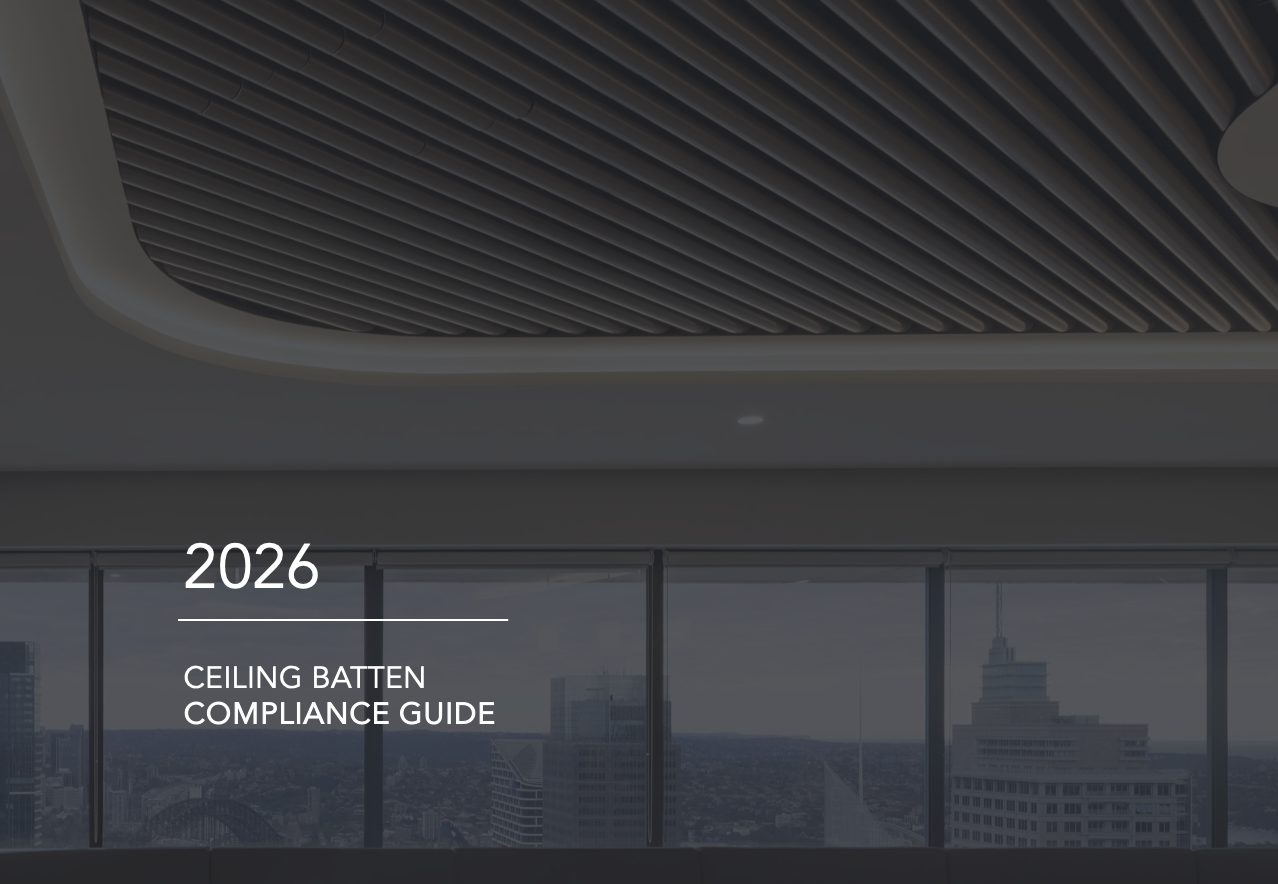
Ceiling Batten Design Compliance in Australia 2026
Australian Standards ● Ceiling Compliance
May 6, 2026
This guide brings together the key considerations for specifying compliant ceiling batten systems in Australia, framing compliance not as a constraint, but as a foundation for better design. It outlines the core standards that govern fire, acoustic and seismic performance, while unpacking how these requirements translate into real-world detailing decisions. From understanding Group Number pathways and full ceiling assembly acoustics, through to navigating AS 1170.4 seismic obligations and material selection, the blog provides a clear, spec-ready framework for architects and designers. It also highlights common pitfalls, coordination strategies and practical checklists, ensuring that design intent, performance and buildability remain aligned from concept through to certification.
PROJECTS LOOKBOOK ⇩A practical, spec-ready guide for Architects and Interior Designs. Building code compliance & design flexibility, addressed in a single place.
Ceiling battens are popular choice for interior applications and are one of those elements that can quietly make or break a design. Done well, they add texture, warmth, and genuine character. Without the right grounding in compliance, they can trigger costly redesigns, hold up the certification process, and create headaches onsite that nobody needs.
The good news is that ceiling batten design compliance in Australia doesn’t have to be complicated. Provided you know which standards apply, where the common paint points are, and how to write a specification that holds up throughout the tender process. This guide sets out to cover this all-in-one location.
Specifying a feature ceiling for a high-end fit-out? A suspended batten system in a commercial office? Or, navigating the acoustic and fire requirements for a school or healthcare project, you’ll find what you need here.


Why Compliance Matters More Than Ever in 2026
Australian building standards have continued to evolve, and ceiling systems are no longer a peripheral consideration in the compliance conversation.
With the 2019 National Construction Code (NCC) amendments now fully embedded in practice and the 2022 NCC updates beginning to be embodied, specifiers are working with tighter performance requirements around fire resistance, seismic considerations, acoustic separation, and thermal performance than ever before.
At the same time, the appetite for architectural ceiling systems has never been stronger. As organisations navigate the ongoing push to bring employees back to the office, interior environments are under pressure to genuinely earn that commute.
Ceiling design, particularly ceilings that make an architectural statement are playing a bigger role than ever before.
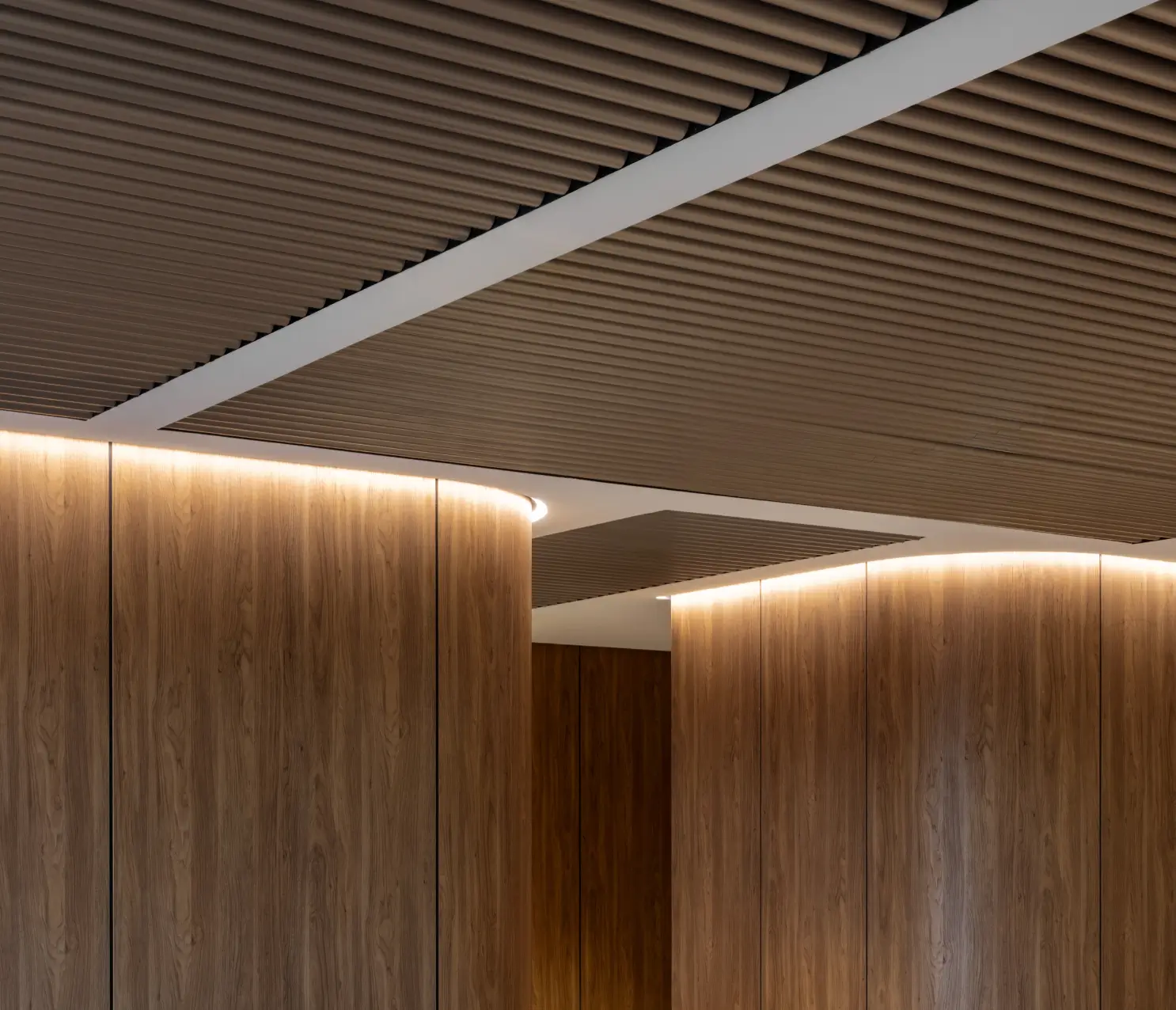
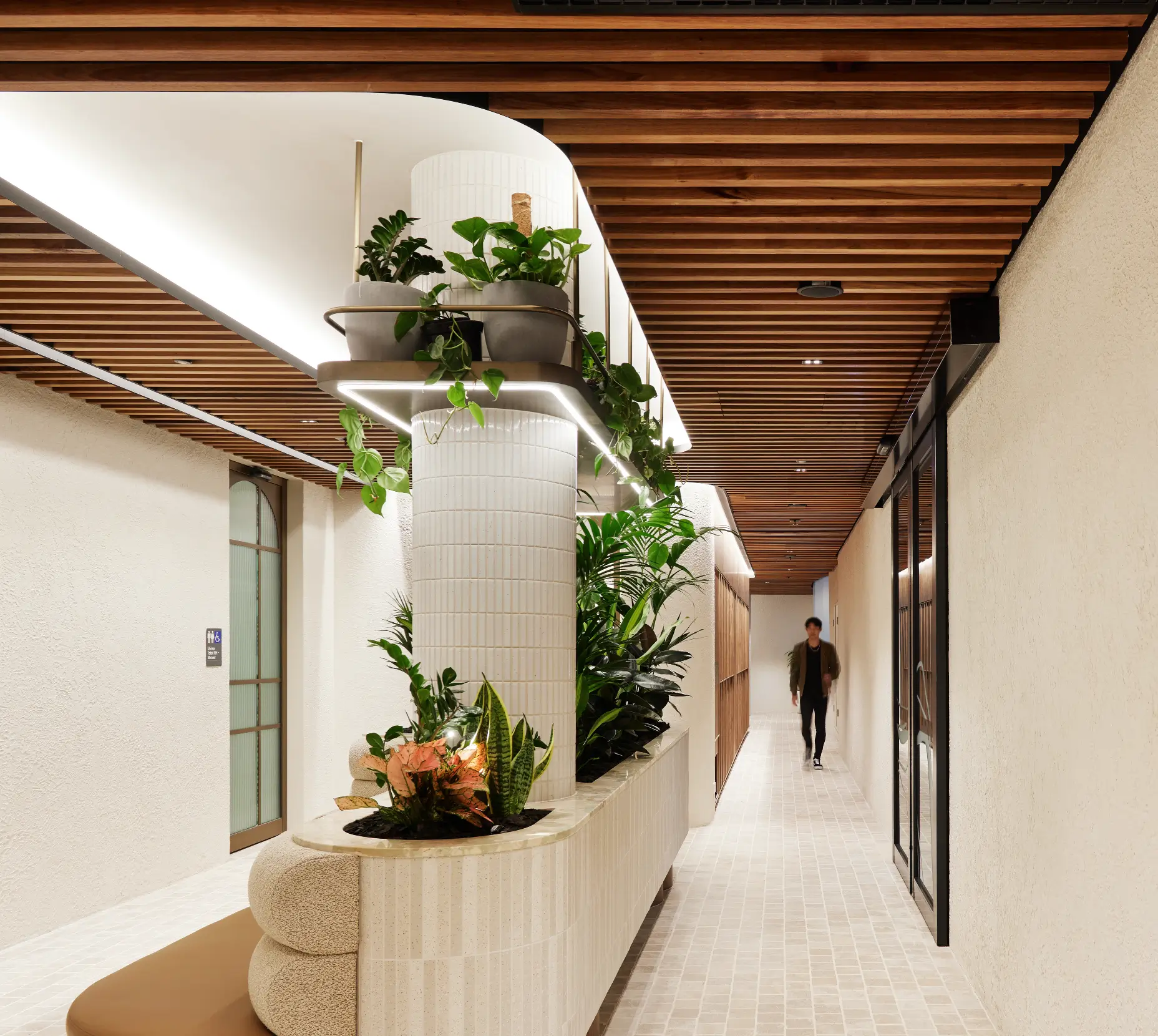
Exposed batten systems and warm material choices are increasingly being called on to make workplaces feel considered and compelling. Architects and Designers are responding with bolder ceilings than ever before. That tensions, between design ambition and compliance rigour, is exactly where a well-written specification has its place.
Compliance is no longer a box-ticking exercise that we deal with at the end of design development. Instead, it’s a set of parameters that should inform you how to detail a ceiling (in this case a batten system) from the very first stages on conceptualisation.
The Standards You Need to Know
Specifiers Note: This table is intended as a starting point. Always confirm applicable standards with your certifier at the outside of a project. This is even more critical when working without healthcare, education & high-rise residential applications where overlay standards can apply.
━━━━━━━━━━
Fire Compliance: What Every Architect & Designer Needs to Know
Fire is where ceiling batten specifications most frequently fall over. Here’s what to look out for.
Group Number and Spread of Flame
Under the NCC, interior finishes (such as ceiling battens) are required to achieve a minimum Group Number rating, which reflects their contribution to the spread of fire. The required Group Number varies by building class and the location of the surface within the building. For example, in a Class 5 Commercial Office, ceiling linings in corridors and exits typically need to meet Group 1 or Group 2 requirements.
There are two pathways to achieving compliance.
The first is a Deemed-to-Satisfy (DTS) solution. This is the standard and most straightforward approach. This pathway uses prescribed materials, methods and components set out by the NCC that are automatically deemed compliant when followed. Aluminium battens are a good example. As a prescribed Group 1 material, they achieve automatic compliance without the need for additional testing or assessment.
The second is a Performance Solution. This is an alternative pathway that allows for tailored designs and innovative approaches to mee the NCC’s Performance Requirements. This is more involved than a DTS and typically requires a conversation with your fire engineer, but it remains a viable route for projects where design intent can’t be achieved through prescribed means. For example, specifying a suitable fire-retardant coating on a timber batten falls into this category. Timber battens do not inherently meet Group 1. In fact, they are Group 3. Some fire-retardant coatings are available that can improve fire performance of timber material to Group 2 or Group 1, but this approach sits outside the traditional bounds of the NCC, and it needs to demonstrate that it meets relevant Performance Requirements.
When pursuing a Performance Solution, there are four accepted assessment methods:
① Evidence of Suitability: Proof that the material or method meets the relevant Performance Requirements, such as a test or certificate from an accredited laboratory (eg. A CodeMark certification).
② Verification Methods: Tests, calculations, or inspections that confirm compliance, with flexibility or alternative methods approved by the relevant authority.
③ Comparison with DTS Provisions: Demonstrating that the alternative solution is equivalent or superior to the DTS pathway.
④ Expert Judgement: A qualified expert’s opinion on compliance used where testing isn’t feasible.
In practice, the DTS pathway is always preferable where design intent allows for it. It’s faster, simpler and leaves less room for interpretation during certification. Where it doesn’t, a well-documented Performance Solution with the right consultant support is entirely achievable.
Our final note on fire retardant coatings is to please take care if exploring this approach. Some fire-retardant coatings can alter the finish appearance significantly. If you would like to explore this approach in greater detail, our recommendation is that you reach out to us to discuss it further.
Clip-In Batten Considerations
Clip-In Batten ceilings (those with visible gas between battens) introduce an additional layer of complexity. The ceiling above becomes part of the assessed fire zone. If the plenum above your batten ceiling contains combustible insulation, cable management, or other elements, this can affect the overall fire performance of the assembly. Your fire engineer needs to assess the full assembly, not just the batten product in isolation.
Sprinkler Coverage
In sprinklered buildings, the gap pattern of your batten ceiling may affect whether the system is deemed to provide adequate covered of the space below. AS 2118 governs automatic fire sprinkler systems in Australia. Here your hydraulics consultant will need to assess whether your batten spacing and clear gaps allow for compliant sprinkler coverage, or whether additional heads are required in the plenum.
Specifiers Quick List for Fire Compliance:
⦿ Confirm the required Group Number for your building class and ceiling location.
⦿ Obtain test certificates for your specified batten product.
⦿ Assess the full ceiling assembly with your fire engineer.
⦿ Coordinate batten gaps with your hydraulics consultant on sprinklered projects.
━━━━━━━━━━
Acoustic Requirements: Why the Full Assembly Matters
Acoustic compliance for ceiling systems is governed by two measures you’ll constantly see referenced in specifications. Rw (weighted sound reduction index, for airborne sound) and Ln,w (weights normalised impact sound pressure level). The NCC sets minimum performance requirements for these by building class and element type.
The critical thing to understand about acoustic performance and ceiling battens is that you cannot assess the batten profile in isolation. The acoustic performance of a ceiling system is a property of the complete assembly. This includes the battens, the substrate or backing, the plenum depth, the insulation within that plenum, and the floor or roof construction above.
- How Batten Design Affects Acoustic Performance
Batten spacing profile depth, and the nature of the gap all influence airborne sound transmission. A densely-spacing batten ceiling with an acoustic backing panel performs very differently to a wide-spaced open style batten ceiling with an empty plenum.
Given the large variable of factors that are often at play across project sites, it can often be tricky to design a ceiling with an already fully tested assembly that accurately considers all contributing elements of the ceiling. In lieu, we often fall back on theoretical calculations. An acoustic consultant can model performance based on comparable assemblies. But this takes time and needs to happen in design development, not at the tail end of documentation.
- Special Applications
In healthcare, education, and performance arts projects, you’re likely working to acoustic performance targets that go beyond the NCC minimums. These environments are often specified in terms of Noise Reduction Coefficient (NRC). This is a measure of how much sound a surface absorbs, relevant to reverberation control and room acoustic quality rather than sound separation. Batten ceilings can perform well in these applications, particularly clip batten systems that include an open area between each batten profile as they allow sound to pass into an acoustically treated plenum.
In commercial office fit outs, a third measure becomes relevant. Ceiling Attenuation Class (CAC) is a measure of how well a suspended ceiling system attenuates sound transmitted laterally through the plenum form one room to an adjacent one. This is a critical consideration wherever meeting rooms, tenancies, or private offices share a common ceiling plenum. A batten ceiling with generous open space and an untreated plenum will perform poorly on CAC, regardless of how well it performs on Rw. If speech privacy between spaces is a design requirement, your ceiling assembly needs to explicitly address sound transfer. Examples of how an assembly could be improved to focus on CAC include an acoustic barrier at partition heads, a plenum infill, or a ceiling system with a demonstrably adequate CAC rating.
The broader point to all of this is that Rw, NRC, and CAC are not interchangeable. Each measures a different acoustic phenomenon and a ceiling assembly that performs well on one acoustic measure does not automatically perform well on the others. Knowing which measure governs your specific context is critical.
Specifiers Quick List for Acoustic Compliance:
⦿ Determine whether your project requires NCC minimum acoustic compliance or higher performance targets.
⦿ Engage an acoustic engineer early to test your full ceiling assembly.
⦿ Reconfirm plenum depth and ceiling contents are consistent with the modelled configuration.
⦿ Where possible, look to detail acoustic insulation in the plenum as part of the ceiling assembly specification.
━━━━━━━━━━
Seismic Compliance: The Australian Standard Most Often Missed
AS 1170.4 is the Australian Standard for Earthquake actions. It is one of the most consistently overlooked compliance requirements in ceiling batten specifications. That’s a problem, because suspended ceiling systems are specifically called out as non-structural components that require seismic restraint design, and the consequences of getting this wrong are serious. A non-compliant ceiling is both a safety risk and a certification issue.
The good news is that AS 1170.4 is not as daunting as it first appears. Here’s what you need to know.
Earthquake Design Categories
AS 1170.4 classifies buildings into Earthquake Design Categories (EDC I, EDC II & EDC III). This is based on two factors:
⦿ The importance level of the builder and
⦿ The seismic hazard at the project location.
Your structural engineer will determine the applicable EDC, but as the architect specifying the ceiling, you need to know what that category means for your detailing.
For EDC I buildings (the lowest category, typically low importance structures in low hazard zones), the compliance requirements for non-structural ceiling components are relatively light. For EDC II and EDC III buildings (which includes most commercial offices, healthcare, and education projects in moderate to high-risk seismic zones), suspended ceiling systems require positive seismic restraint. This is bracing, seismic clips, and perimeter relief details that allow the ceiling to move without failing.
What ‘Seismic Restraint’ Actually Means for Battens
For suspended batten ceiling systems, seismic restraint design typically addresses three things.
① She suspension system itself. Hangers and fixing must be designed to resist both vertical and lateral seismic loads, not just the static dead load of the ceiling.
② The perimeter condition. Batten ceilings need a perimeter relief gap (typically 10-20mm) that allows the ceiling plan to deflect during a seismic event without the edge of the ceiling bearing against the wall an causing progressive collapse.
③ Bracing. Diagonal seismic brace wires or rigid brace assemblies are required at specified intervals to limit lateral movement of the ceiling grid.
None of this is inherently incompatible with a well-designed architectural batten ceiling. But it does not to be considered. For example, if you consider the need for a compliant seismic relief joint from the start, you can include this as a neat visual termination.
Jurisdiction Matters
Seismic hazard in Australia varies significantly by location. Perth, Adelaide, and parts of regional Australia sit in higher seismic hazard zones than Sydney or Melbourne. If you’re working across multiple states or projects in regional areas, don’t assume the seismic requirements form your last project apply. Always confirm the hazard classification for the specific site with your structural engineer.
Specifier’s Note: AS 1170.5 compliance for non-structural components is a structural engineering responsibility. But the ceiling assembly you specify has to be capable of accommodate the seismic restraint solution. Engage your structural engineer before you finalise your batten ceiling detail, not after. A last-minute seismic brace retrofit into a resolved ceiling layout is nobody’s idea of a good outcome.
Specifiers Quick List for Seismic Compliance:
⦿ Confirm the Earthquake Design Category (EDC) for your project with the structural engineer.
⦿ Understand the seismic hazard classification or the specific project location.
⦿ Ensure your ceiling suspension systems designed for seismic lateral and vertical loads, not just dead load.
⦿ Detail perimeter relief gaps explicitly. Size them to meet AS 1170.4 requirements for the applicable EDC.
━━━━━━━━━━
Material and Installation Standards
Compliance isn’t only about fire, acoustics, and seismic performance. The materials you specify and the way the system is detailed for installation both have a direct compliance implication.
- Timber Battens
When specifying timber battens, the relevant considerations include moisture content (AS/NZS 4787 for engineered wood products), treatment requirements for internal use, and finishing. For feature ceilings in commercial projects, specifying a kiln-dried, clear-grade hardwood is common. Please remember that timber does not inherently meet Group 1. Importantly, not all timber specie or profiles carry a tested fire data. If you’re working with a bespoke profile or unusual species, budget for testing time or work with a supplier who has an existing test certificate that covers your configuration.
- Aluminium Battens
Aluminium extrusions are inherently non-combustible and will achieve Group 1 fire ratings without additional treatment. However, the substrate and attachment system still matter. Concealed fixings into a combustible substrate, or an incorrect suspension system can undermine the overall assembly performance.
For aluminium battens specifically, confirm the alloy grade and finish are appropriate for the project environment. Coastal and high-humidity environments require specific alloy and coating specifications to meet durability requirements.
- The Suspension System
A commonly overlooked area of ceiling batten compliance is the suspension system itself. The framing, hangers and fixings that support a batten ceiling are subject to structural compliance requirements under AS 3623 (domestic metal framing), AS 1418 (building framing) and manufacturer-specific installation requirements. Where seismic restraint is required under AS 1170.4, the suspended system must also be designed and installed to accommodate lateral seismic loads and bracing, which adds another layer of coordination with your structural engineer.
The golden rule: The suspension system must be specified in full as part of the ceiling assembly documentation. A batten ceiling suspended from an unspecified or non-compliant grid is a liability waiting.
Specifiers Quick List for Material & Installation Compliance:
⦿ Obtain fire test certificate your specified material.
⦿ For aluminium battens in coastal or humid environments, specify alloy grade and coating systems.
⦿ Include the complete suspension system in your ceiling specification (this includes framing and hangers).
⦿ Confirm fixing centres and hanger loads comply with the system manufacturer’s installation requirements.
━━━━━━━━━━
Detailing for Design Flexibility Without Losing Compliance
This is the real challenge, and the part where having a strong relationship with your ceiling system supplier pays dividends. Here’s a framework for approaching ceiling batten detailing in a way that preserves design intent while keeping compliance firmly in view.
① Establish your compliance parameters first
Before you commit to a batten profile or spacing, define the fire, acoustic, seismic, and structural requirements of the specific location within the building. Corridor ceilings, open plan office ceilings, and tenancy separating ceilings all have different compliance envelopes. In higher EDC buildings, the seismic restraint requirements may influence your suspension system design before you’ve even selected a batten profile. Knowing your parameters upfront prevents costly late-stage redesigns.
② Have an Acoustic Consultant model your ceiling assembly early
Tested ceiling assemblies that match your exact on-site ceiling assembly are rare. Instead, our recommendation is that you reach out t your acoustic consultant with our desired ceiling assembly (in full) and have them model calculations to determine it’s performance. Be prepared that this may take some time and be an iterative process.
③ Detail transitions clearly
Compliance problems in ceiling systems almost always occur at transitions. Where a batten ceiling meets a wall, a different ceiling system, a structural penetration, or a service element. This is also where seismic relief gaps need to be resolved. Your perimeter detail most accommodate the required movement under AS 1170.4 while still looking considered. A perimeter shadow gap can do both jobs elegantly, but only if it’s sized and documented correctly. Detail every transition clearly in your documentation. A clean design that’s ambiguous at the junctions is a specification that will be resolved on-site, often incorrectly.
④ Coordinate services early
Mechanical, electrical, hydraulic, and fire services all interact with ceiling batten systems in a way that affect compliance. Downlights in a fire-rated ceiling assembly require compliant fire collars or covers. HVAC diffusers in an open batten ceiling need to be designed into the batten geometry. Get your service consultant into the coordination model before you finalise your batten layout.
⑤ Write a specification that contractors can build from
The best ceiling batten design fails if the specification leaves contractors to make compliance decisions onsite. Your spec should name the product (or an approved equal with defined equivalency criteria), reference the relevant standards, tolerance requirements, and finishing instructions. Don’t leave gaps that invite on-site improvisation.
⑥ Document your compliance rationale
Particularly on complex or bespoke ceiling systems, maintain a record of your compliance decision-making. Which standards you’ve applied. Which consultant advice you’ve relied on. What test data supports your specification. This record is invaluable if the project is queried during certification, and it demonstrates the professional diligence that protects your practice.
━━━━━━━━━━
Common Specification Mistakes (And How to Avoid Them)
After working with Architects and Designers across countless ceiling batten projects, a few recurring specification errors have begun to stand out. Here are the one’s worth knowing.
- Treating Seismic Restraint as the Structural Engineer’s Problem Alone
AS 1170.4 compliance for non-structural components is a shared responsibility. Yes, your structural engineer determines the EDC and designs the restraint system, but the ceiling assembly you’ve specified has to be capable of accommodating it. F your perimeter detailing doesn’t allow for a seismic relief gap, or your suspension system isn’t compatible with seismic bracing, you’ll be redesigning late in the piece. Get the structural engineer involved in the ceiling coordination conversation early.
- Specifying the Batten Without the Assembly
The batten profile is only one element of a ceiling assembly. Specifying the batten in isolation, without the suspension system, backing, and other plenum treatments, leaves your specification incomplete and your compliance position exposed.
- Ignoring the Plenum
For open batten ceiling systems (those without acoustic insulation incorporated into the system itself), what sites above the ceiling plane is as important as what’s visible below it. An untreated, combustible-loaded plenum above an open ceiling can completely change the fire and acoustic performance landscape.
- Late Engagement of Consultants
Fire engineers, acoustic consultants and structural engineers asked to review a finalised ceiling design at the end of documentation will often identify issues that require design changes. Engaging all three consultants during design development (when changes are cheap) is always the smarter approach. Brief them on your design intent and rely on their niche expertise to guide your finished drawings.
A Quick Compliance Checklist for Your Next Batten Project
The below is a practical cross-check before your next ceiling batten specification goes to tender
○ Building class and applicable NCC volume confirmed
○ Required Group Number (fire) identified for each ceiling location
○ Acoustic performance targets defined
○ Earthquake Design Category (EDC) confirmed with structural engineer
○ Seismic hazard classification verified for specific project location
○ Perimeter relief gaps sized and detailed to meet AS 1170.4, for the applicable EDC
○ Complete ceiling assembly documented (battens, suspension, backing & plenum treatment)
○ Full assembly modelled by acoustic engineer and confirmed it meets your acoustic performance targets
○ Fire test certificates requested and reviewed
○ Sprinkler coverage coordinate with hydraulics consultant
○ Service coordination completed (downlights, HVAC, fire services)
○ State/Territory NCC amendments checked and applied
○ Compliance rationale documented and filed with project records
━━━━━━━━━━
The Takeaway
Ceiling batten design compliance in Australia isn’t a constraint. The Architects and Interior Designers who consistently produce outstanding ceiling outcomes are the ones who understand the compliance framework well enough ow ork confidently within it, and to push against its boundaries with intention, rather than ignorance.
At MBS Architectural, we work alongside specifiers through the project process. From early design development conversations to final specification review. If you’re working on a ceiling batten project and want to talk through your compliance approach, we’re always happy to help.

Our architectural team is here to collaborate on ideas, materiality and budget from day one. Drop us a note at hello@mbsarchitectural.com.au or call 03 9580 7800 to start the conversation.
Every material.one source.
Let's bring your project to life.





.svg)