
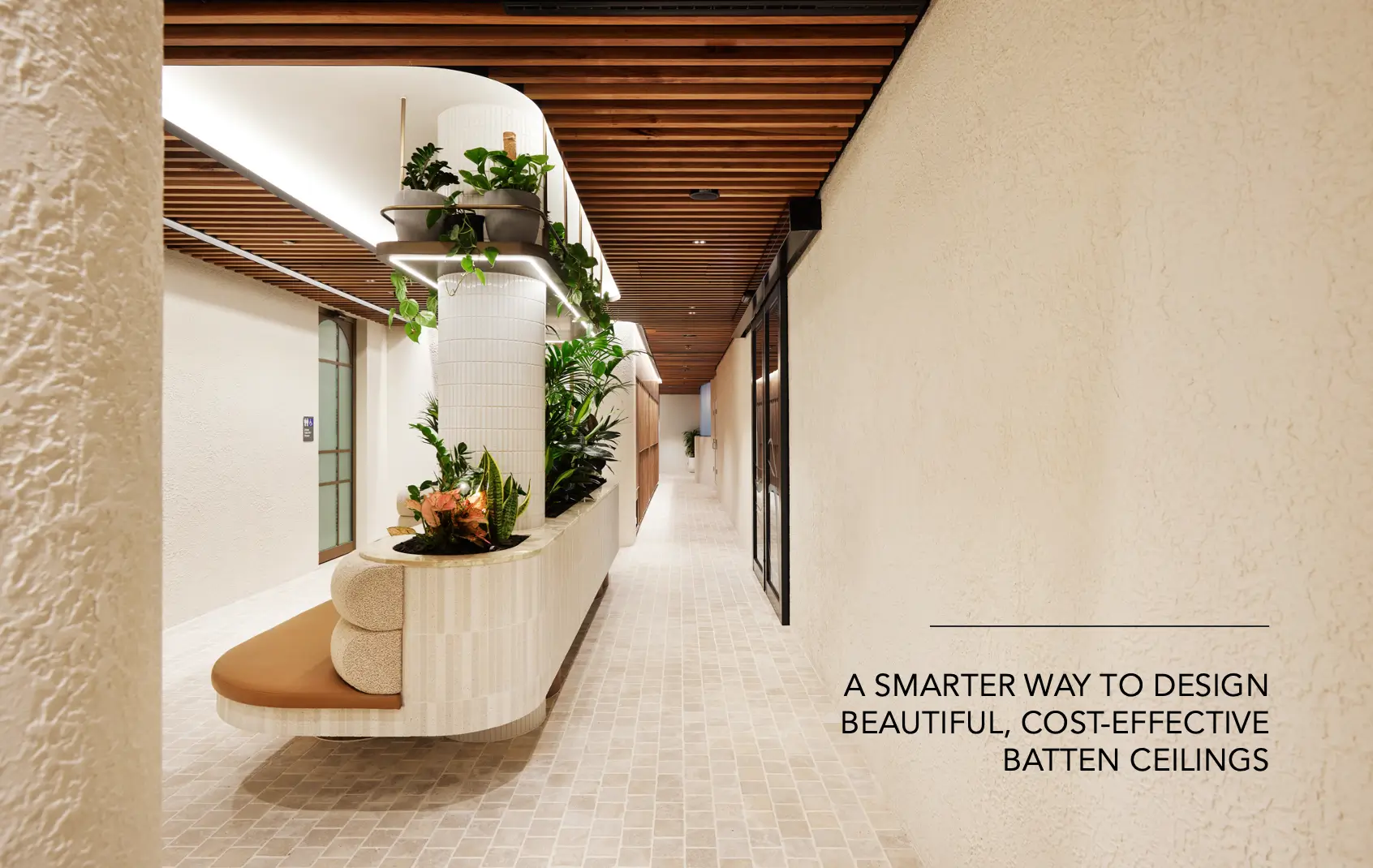
The Golden Rule of Timber Batten Spacing
Timber Batten Ceilings ● Ceiling Design Efficiency
April 30, 2026
Timber batten spacing plays a critical role in both the visual outcome and cost of a ceiling design. This article explores how proportion, viewing angle, and material efficiency intersect, introducing the two thirds rule as a reliable starting point for spacing. It examines how tighter gaps can lead to unnecessary material use, and how adjusting batten depth can achieve the same visual density more efficiently. A practical guide for architects and designers seeking to balance aesthetic intent with cost-effective outcomes.
PROJECTS LOOKBOOK ⇩There is a moment in every project where a seemingly small decision begins to carry unexpected weight.
For timber batten ceilings, that moment often comes down to a single question:
What gap should sit between each batten?
It sounds straightforward. But in reality, this one decision has the power to shape both the visual character of a space and the overall cost of delivering it. It influences how the ceiling is read, how light moves across it, and how much of the material you are specifying is actually seen.
At first glance, tighter spacing feels like the obvious choice. A narrow gap creates density. It gives the ceiling a sense of solidity and richness, a more architectural presence overhead. But that density comes at a cost. More battens are required across the same area, increasing both material use and installation time. The ceiling becomes heavier, both visually and financially.
Open the spacing, and the opposite begins to happen. The ceiling lightens. Material use drops. Installation becomes more efficient. But push it too far, and the rhythm can start to break down. The intent softens. The design risks losing the clarity that made it compelling in the first place.
This is where a simple rule begins to prove its value.
A reliable starting point is to set the gap at two thirds of the batten depth. A 60 millimetre deep batten pairs naturally with a 40 millimetre gap. A 30 millimetre profile works comfortably with a 20 millimetre spacing. It is a proportion that holds across a wide range of applications, not because it is arbitrary, but because it aligns with how we actually experience space.
Ceilings are rarely viewed head on. Instead, they are read at an angle, often around forty five degrees as people move through a room. At that angle, the relationship between depth and gap becomes critical. The two thirds proportion ensures that enough of the batten depth remains visible, allowing the ceiling to express its texture, rhythm and shadow.
When the gap is too tight, much of that depth disappears from view. The battens are still there, but their presence is diminished. You are specifying material that is technically installed, but visually lost. The ceiling reads flatter than intended, and the richness you were aiming for never fully materialises.

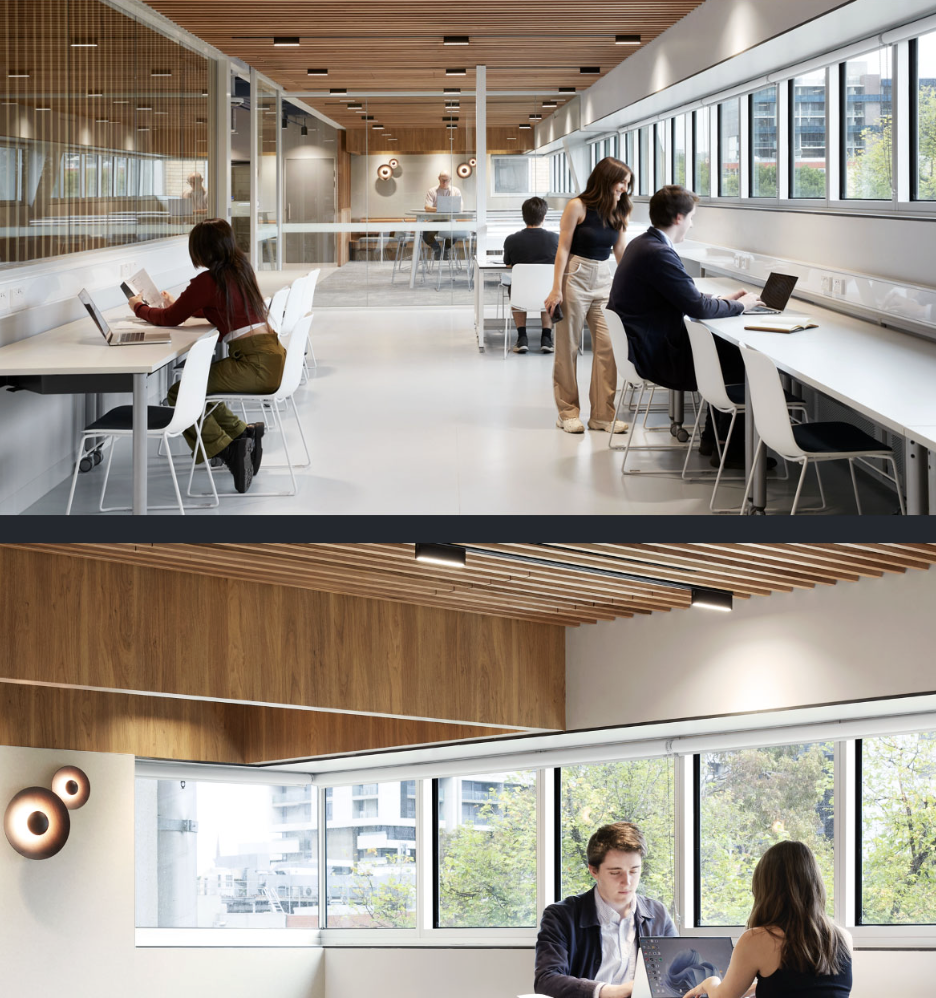


Consider a deeper profile, say 60 millimetres, paired with a narrow 10 millimetre gap. On paper, it suggests a dense, high-end outcome. In reality, from a natural viewing angle, a significant portion of that depth is concealed. The ceiling carries the cost of a larger section, without delivering the full visual return.Open that gap, and the transformation is immediate. More of the batten becomes visible. The ceiling gains clarity and depth. The rhythm sharpens. At the same time, the amount of material required reduces, bringing efficiency back into the design without compromising its intent.
Interestingly, the rule becomes even more powerful when the design calls for density.
If the goal is a tight, controlled gap, the instinct is often to maintain a deeper batten. But a more resolved approach is to reduce the depth instead. A 30 millimetre batten paired with a 10 millimetre gap will read almost identically to a deeper profile at the same spacing. The visual outcome remains consistent, but the material use drops significantly.

In many cases, this shift alone can reduce costs by thirty five to forty percent or more.
What emerges is not a compromise, but a refinement. The same design intent, expressed more efficiently.
Ultimately, timber batten spacing is less about rigid rules and more about understanding proportion. It is one of the simplest levers available to designers, yet one of the most impactful. When considered carefully, it allows you to control cost, enhance visual clarity, and ensure that every element specified contributes meaningfully to the space.
Because good design is not about using more. It is about using just enough, in exactly the right way.


Our architectural team is here to collaborate on ideas, materiality and budget from day one. Drop us a note at hello@mbsarchitectural.com.au or call 03 9580 7800 to start the conversation.
Every material.one source.
Let's bring your project to life.





.svg)