
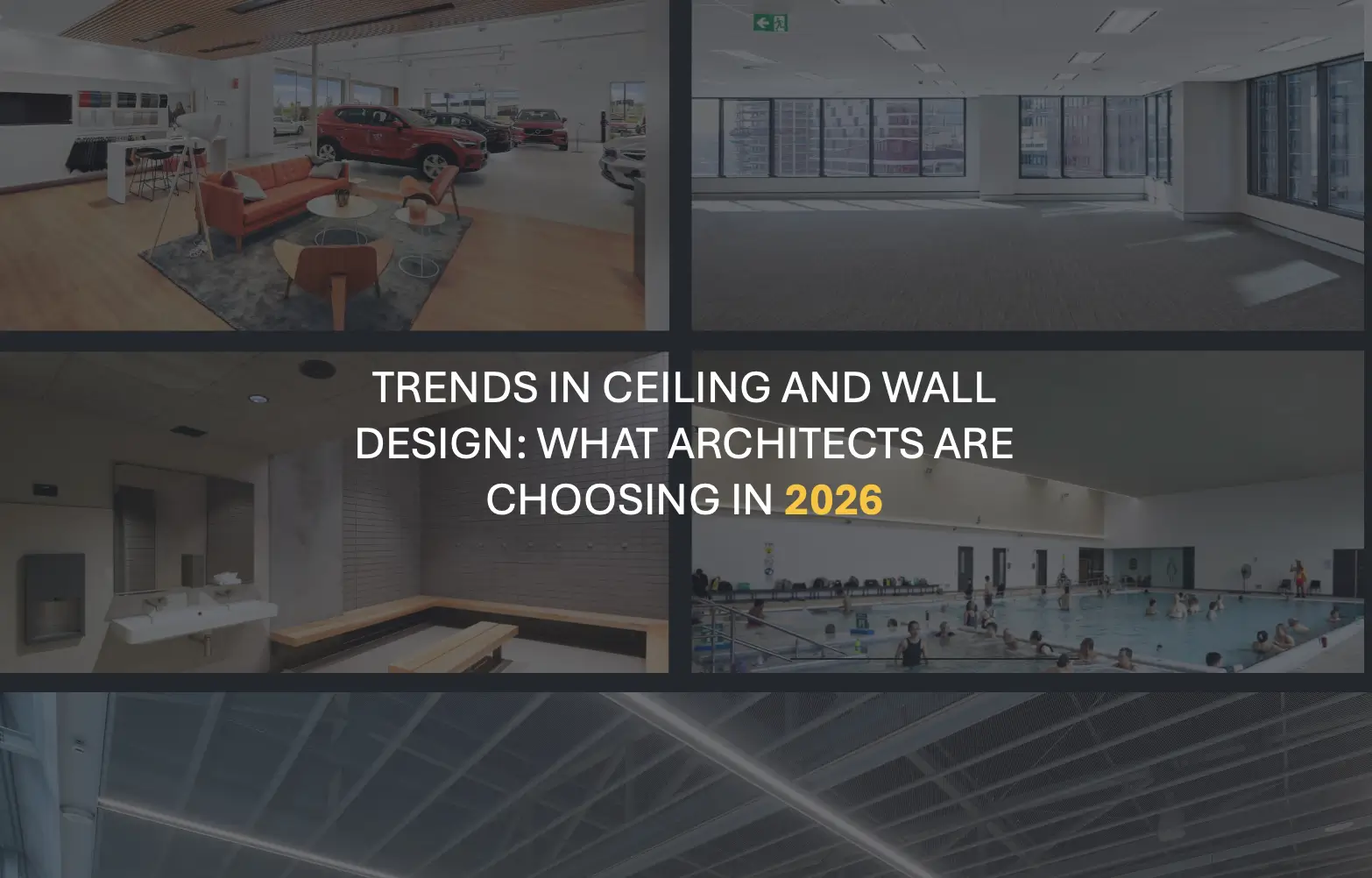
Trends in Ceiling and Wall Design: What Architects Are Choosing in 2026
Sustainable Materiality ● Customisable Systems
June 26, 2025
Ceiling and wall systems have become critical drivers of architectural performance and experience, evolving beyond aesthetics into tools for wellbeing, sustainability, and technical integration. This article explores how 2026 design trends are reshaping specification—where biophilic materiality, advanced customisation, and low-carbon thinking converge. It examines how architects are leveraging these systems to deliver spaces that are more adaptable, environmentally responsible, and experientially refined.
PROJECTS LOOKBOOK ⇩In 2026, ceilings and walls are no longer passive surfaces. They have become active participants in how architecture performs, feels, and endures—quietly shaping the experience of space while responding to an increasingly complex set of demands.
What has emerged is not a singular aesthetic trend, but a recalibration of priorities. Designers are no longer asking what a surface looks like in isolation, but what it contributes to the broader environment. Performance, adaptability, and environmental responsibility are no longer layered considerations—they are embedded from the outset.
This shift is most evident in the continued evolution of biophilic design. Where once the approach centred on the introduction of timber tones or natural finishes, it has matured into something more holistic. In 2026, biophilic design is less about imitation and more about experience—how materials influence comfort, acoustics, and emotional response.
Timber battens and wood wool panels remain central to this conversation, not simply for their visual warmth, but for their ability to soften the acoustic profile of a space. In workplaces, education environments, and healthcare settings, this dual role has become essential. The ceiling is no longer just seen—it is heard, and increasingly, it is felt.
Designers are also exploring more spatially expressive applications. Layered ceiling systems, varied batten spacing, and subtle shifts in depth introduce rhythm and movement overhead. These interventions create a sense of calm and cohesion, while reinforcing the architectural language of the space.
Alongside this, the demand for customisation has accelerated. In 2026, standard solutions are rarely sufficient. Architects are seeking systems that can be tailored—precisely and efficiently—to the needs of each project. This is not customisation for its own sake, but a response to increasingly complex briefs.
Aluminium battens, metal ceiling systems, and integrated wall solutions are now expected to adapt to varied geometries, align with services, and accommodate lighting and acoustic performance without compromise. Profiles are adjusted, finishes are layered, and colour is used with greater intentionality. The result is a level of resolution that feels considered rather than assembled.


Flexibility underpins this approach. Systems must be capable of evolving alongside the project—integrating seamlessly with mechanical and electrical services, responding to spatial constraints, and maintaining buildability on site. The most successful solutions are those that simplify complexity, allowing design ambition to be realised without unnecessary friction during construction.
At the same time, sustainability has moved from aspiration to expectation. In 2026, material selection is increasingly informed by measurable outcomes—embodied carbon, recyclability, and lifecycle performance are now fundamental to specification.
Recyclable metals, responsibly sourced timber, mineral fibre, and wood wool systems continue to gain traction, not only for their environmental credentials but for their ability to perform at a high level over time. Certifications such as Green Star and WELL remain influential, but the conversation has broadened. There is a growing emphasis on circularity—how materials can be disassembled, reused, or reconfigured as buildings evolve.
Longevity has become a defining metric. Systems that can be maintained, adapted, or replaced in part—rather than in full—offer both environmental and economic advantages. Demountability, in particular, is shaping how ceiling and wall systems are designed, ensuring that today’s solutions remain viable well into the future.
What defines 2026 is this convergence. Aesthetic ambition is no longer pursued at the expense of performance, and sustainability is no longer treated as a secondary layer. Instead, these elements are resolved together, informing each decision with greater precision.
For architects and designers, this creates a more demanding—but ultimately more rewarding—design process. The materials and systems available today offer an unprecedented level of control, enabling outcomes that are both technically rigorous and visually compelling.
At MBS Architectural, this is where our focus remains. Supporting the integration of performance, materiality, and design intent to deliver ceiling and wall systems that do more than complete a space—they define it.
In this evolving landscape, ceilings and walls are no longer just part of the architecture. They are instruments of it—shaping how spaces are experienced, understood, and remembered.


Our architectural team is here to collaborate on ideas, materiality and budget from day one. Drop us a note at hello@mbsarchitectural.com.au or call 03 9580 7800 to start the conversation.
Every material.one source.
Let's bring your project to life.





.svg)