

Innovative Suspended Ceiling Systems: A Designer’s Guide
Interior Design ● Ceiling Systems
January 28, 2026
Suspended ceilings have evolved far beyond their traditional role as purely functional building elements. Today, they are fundamental architectural tools capable of shaping atmosphere, improving acoustics, integrating services and reinforcing the overall design language of a space. This article explores the wide spectrum of suspended ceiling systems available to architects and interior designers, from sleek concealed metal panels and expressive aluminium battens through to expanded mesh, raft systems and highly acoustic wood wool solutions. Each system brings its own visual identity and technical strengths, allowing designers to balance performance, maintenance, aesthetics and budget with increasing precision. Whether the intent is minimal and refined, warm and tactile, or bold and industrial, suspended ceilings have become an essential layer in contemporary architecture — quietly influencing how spaces feel, function and perform every day.
PROJECTS LOOKBOOK ⇩
Suspended Ceiling Systems: Shaping the Fifth Elevation
For decades, ceilings were often treated as an afterthought. Functional. Necessary. Something to conceal structure and services before attention returned to the architecture happening at eye level.
Not anymore.
Today, the ceiling has become one of the defining architectural surfaces within contemporary design. It controls acoustics, frames light, conceals complexity and influences how a space feels long before occupants consciously register it. Increasingly, architects and interior designers are treating the ceiling not as background infrastructure, but as an integral part of the architectural experience.
And at the centre of this evolution sits the suspended ceiling system.
At MBS Architectural, we work across a broad spectrum of suspended ceiling applications — each offering its own balance of aesthetics, performance, accessibility and cost efficiency. The beauty of suspended ceilings lies in this versatility. There is no singular solution. Instead, there is a toolkit of systems capable of responding to vastly different architectural intents.
Because no two spaces ask the ceiling to do the same thing.

Exposed Grid Systems: Simplicity with Purpose
Sometimes, the best solution is the most honest one.
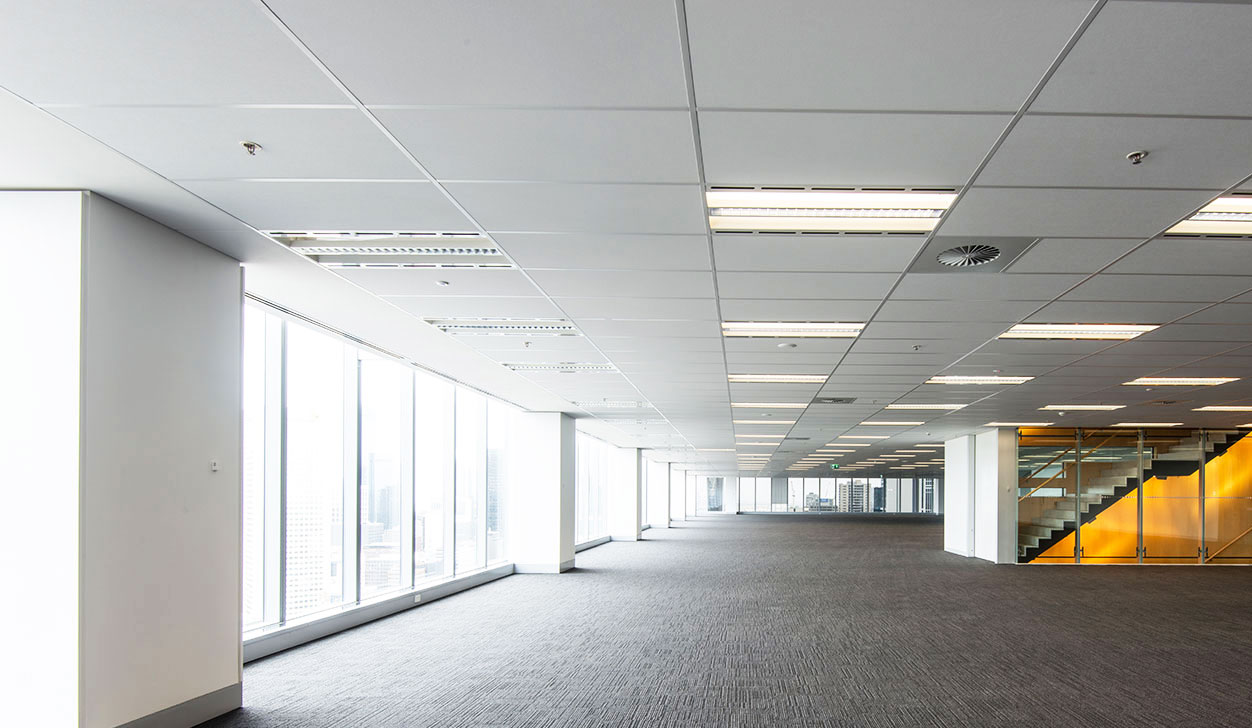
Exposed grid ceiling systems have long been a staple of commercial architecture due to their practicality, efficiency and ease of maintenance. Mineral fibre tiles sitting within a visible suspension grid offer excellent accessibility to services above the ceiling plane, making them particularly suited to environments where ongoing maintenance and flexibility are essential.
But practicality no longer comes at the expense of aesthetics.
Modern exposed grid systems have evolved significantly, with cleaner grid profiles, refined tile textures and improved acoustic performance elevating their architectural potential. In education environments, workplaces and healthcare projects, these systems continue to provide a highly efficient and cost-effective solution while maintaining a calm and cohesive visual language.
⦿ Cost-effective installation and maintenance
⦿ Easy access to services and infrastructure
⦿ Excellent acoustic performance options
⦿ Suitable for large-scale commercial environments
Functionality may drive the decision initially. Good detailing is what makes them feel considered.
Concealed Grid Systems: Refined and Seamless
Where exposed grids celebrate accessibility, concealed systems aim for visual purity.
Concealed hook-on and clip-in ceiling systems create smooth, uninterrupted ceiling planes that allow the architecture itself to take centre stage. With the suspension system hidden from view, the ceiling reads as a continuous architectural surface rather than a modular assembly.
This is particularly powerful in premium commercial spaces, transport infrastructure and hospitality environments where refinement and continuity are central to the design language.
At projects such as Melbourne Airport T2 Arrivals Hall, perforated metal hook-on panels create expansive ceiling planes that feel elegant, calm and highly resolved despite the enormous technical coordination happening behind them. Lighting, sprinklers, HVAC systems and access requirements are all integrated seamlessly into the system without disrupting the overall visual clarity.
The result feels effortless.
Of course, it rarely is.
Aluminium and Timber Battens: Rhythm, Warmth and Depth
Few ceiling systems have shaped contemporary architecture quite like battens.
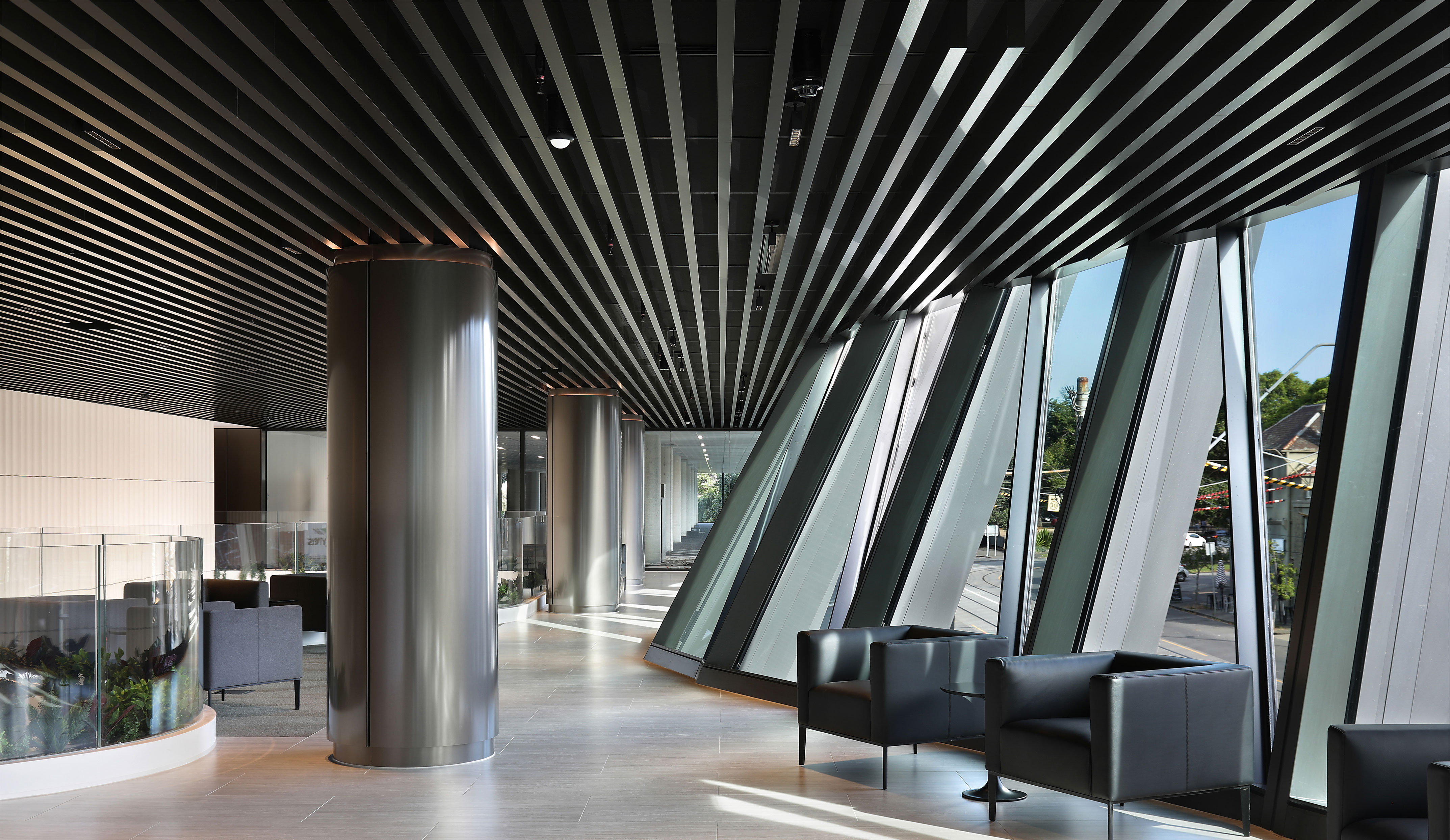
Whether aluminium or timber, batten systems introduce rhythm, texture and movement into a space in a way few other ceiling types can achieve. The repetition of profile and shadow transforms flat ceiling planes into layered architectural surfaces, while the spacing between battens allows light, airflow and services to integrate naturally into the design.
The flexibility of battens is what makes them so compelling.
Slim tubular profiles can feel delicate and refined. Deep architectural blades create drama and scale. Timber-look aluminium battens bring warmth without the maintenance and fire concerns associated with natural timber. Powder coated finishes can either soften or intensify the visual language of a space depending on colour and sheen selection.
At projects such as 11 Eastern Road by Rothelowman, oversized aluminium battens create bold linear geometry that anchors the double-height lobby beneath them. Elsewhere, battens are used more subtly — softening workplace interiors or introducing warmth into public environments.
They can disappear quietly into a design.
Or completely define it.
Expanded Mesh: Industrial Yet Elegant
Expanded mesh ceiling systems occupy a fascinating space between openness and enclosure.
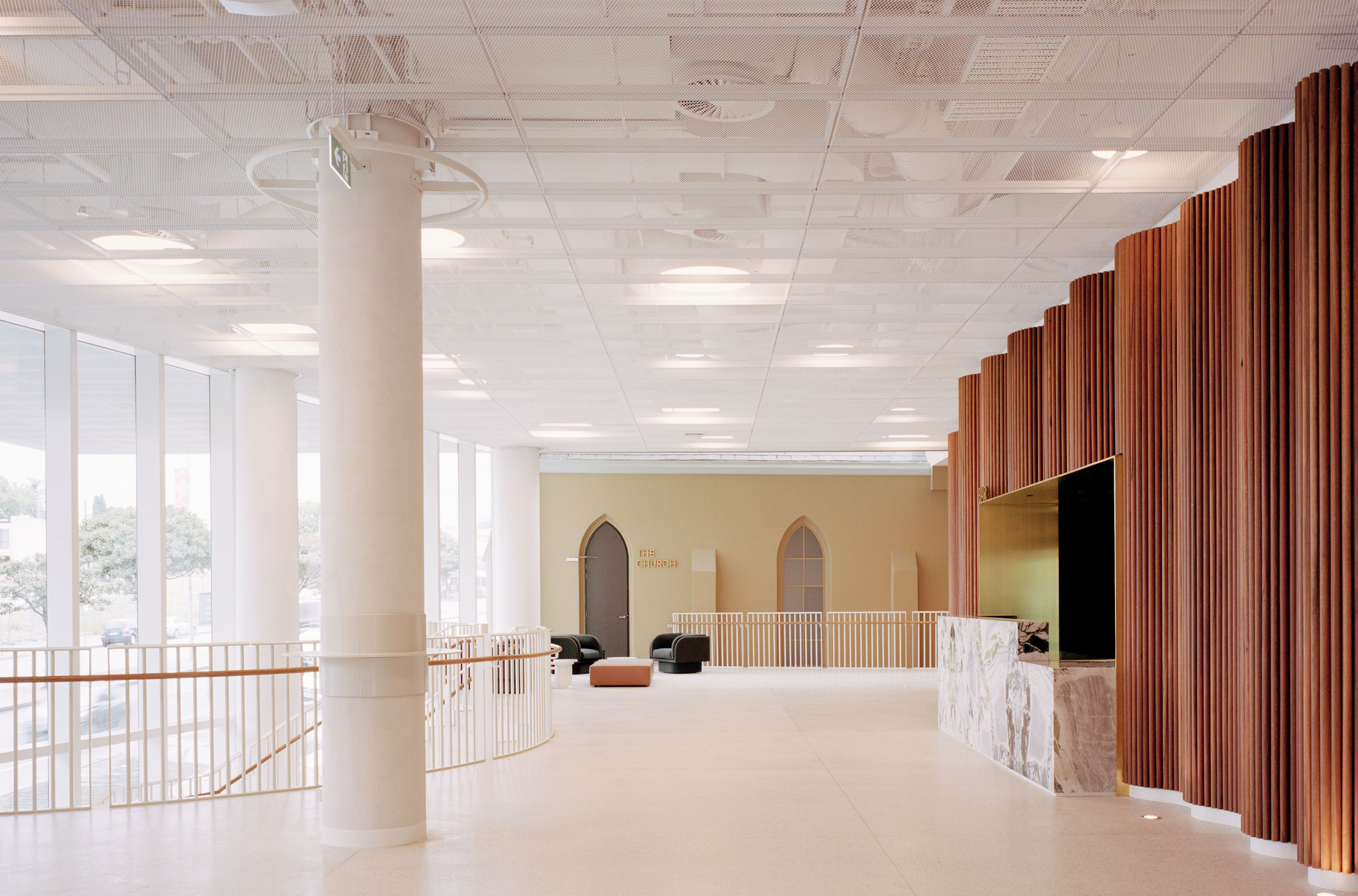
Their semi-transparent nature allows airflow, lighting and services to interact dynamically with the ceiling plane while introducing texture, shadow and depth. In public architecture especially, expanded mesh has become increasingly popular for its ability to create visually striking ceilings that still feel lightweight and breathable.
At the Geelong Performing Arts Centre, expanded mesh soffits flow seamlessly from exterior canopy spaces into the internal architecture, creating continuity between inside and out. The material introduces an industrial quality while simultaneously feeling refined and sculptural.
This duality is what makes expanded mesh so successful.
It feels robust yet delicate. Open yet controlled.
And when paired with thoughtful lighting design, the resulting shadow play can become an architectural feature in itself.
Open Cell Systems: Designed for Contemporary Spaces
Open cell ceilings continue to gain popularity within retail and commercial environments where designers are seeking ceilings that feel highly contemporary while maintaining openness and flexibility.
By creating a geometric grid of open cells, these systems allow services, lighting and air movement to integrate naturally into the architecture while still providing a highly ordered visual framework. The result often feels crisp, lightweight and deeply architectural.
Their ability to maintain openness while still concealing visual clutter makes them particularly effective in shopping centres, transport hubs and collaborative workplace environments where exposed services alone may feel visually unresolved.
Open cell systems sit somewhere between architecture and infrastructure.
And that’s exactly their strength.
Raft Ceilings: Defining Space Without Walls
As workplaces and public interiors become increasingly open-plan, designers are searching for ways to define zones without introducing solid partitions.
Raft ceiling systems answer this beautifully.
Suspended independently beneath the structural soffit, rafts create floating architectural forms that help shape breakout zones, meeting spaces and collaborative environments. Acoustically, they are incredibly effective, helping absorb sound while visually lowering scale within large open spaces.
More importantly, they allow flexibility.
Spaces remain open and connected, yet still feel intentionally organised and human in scale.
It’s architecture doing more with less.
Linear Metal Ceilings: Durable and Highly Adaptable
Linear metal ceiling systems have become synonymous with contemporary commercial architecture.
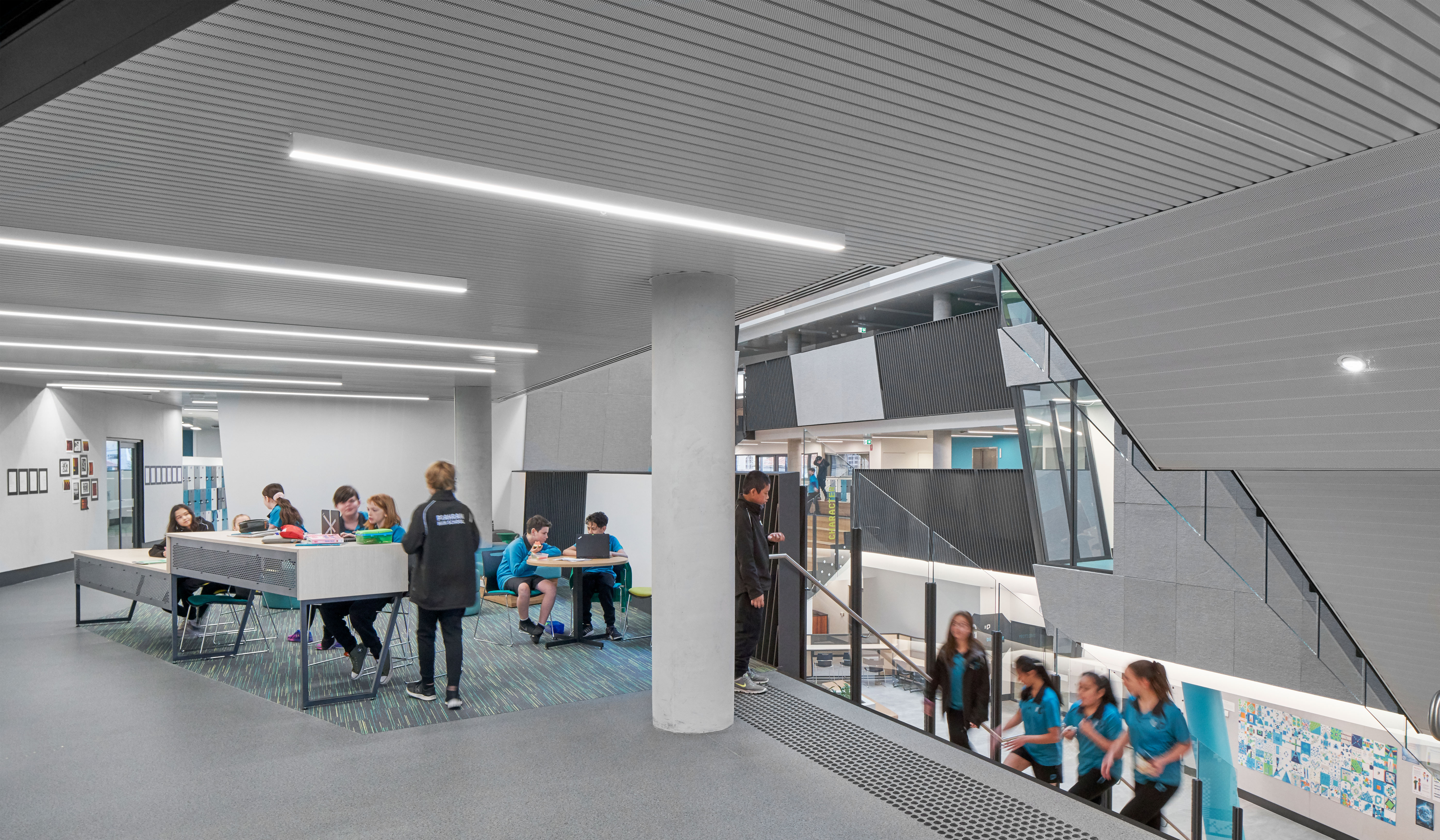
Their appeal lies in their simplicity. Long linear profiles create clean directional movement through a space while offering exceptional durability and service integration flexibility. Available in an extensive range of finishes, perforation patterns and profile sizes, linear systems can adapt to everything from airports and schools through to hospitality and retail environments.
At Prahran High School, linear metal systems work alongside perforated metal tiles and sculptural ceiling forms to reinforce the bold geometric language of the architecture. The ceiling becomes an active contributor to the identity of the space rather than simply a background surface.
This is increasingly the expectation of modern ceilings.
To perform technically while also carrying architectural intent.
Wood Wool: Acoustic Performance with Warmth
Few materials balance acoustic performance and visual warmth quite like wood wool.
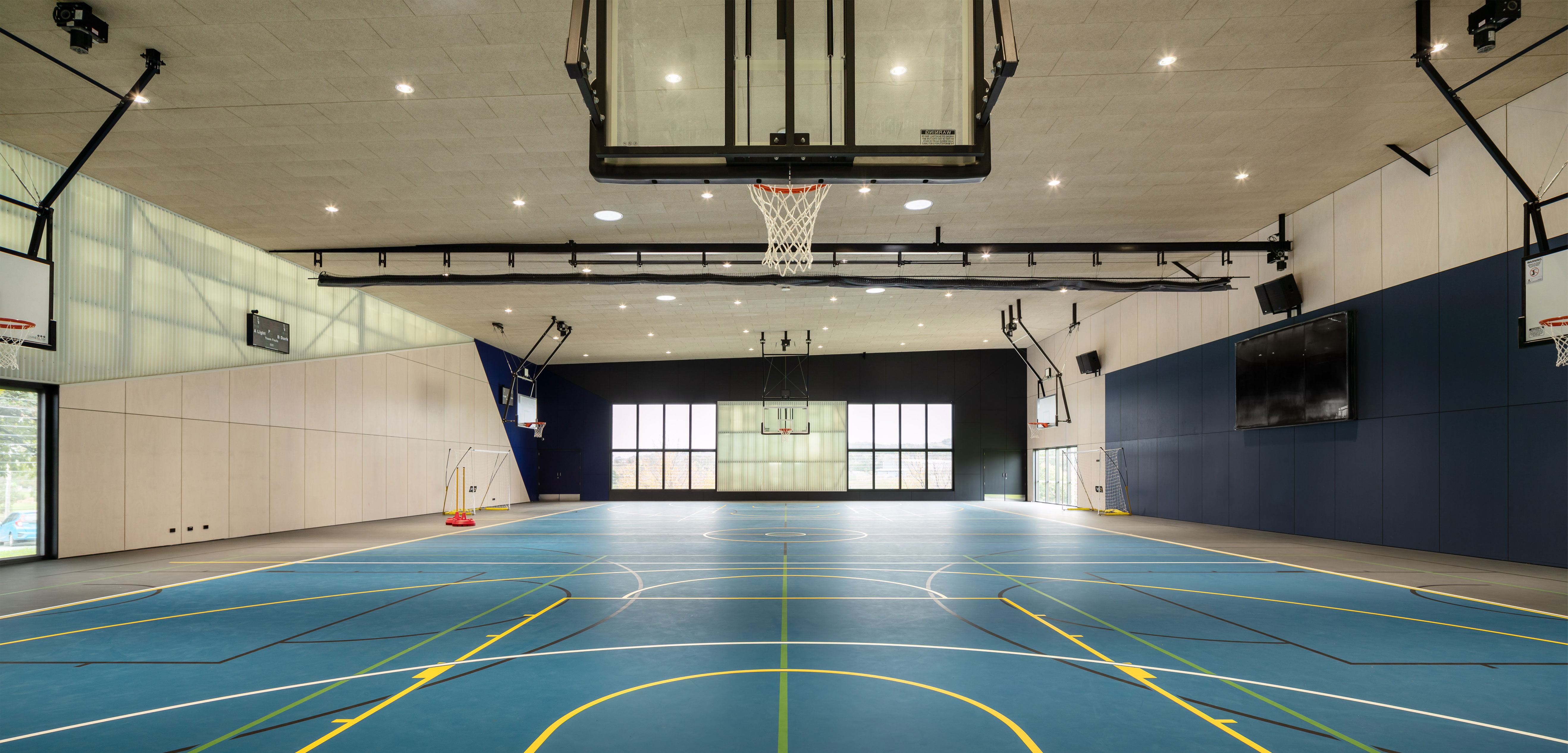
Its organic texture immediately softens a space, introducing tactility and warmth often missing from highly technical environments. But beyond aesthetics, wood wool systems deliver exceptional acoustic absorption, making them particularly suited to education, hospitality, sports and public assembly environments.
In projects such as Heritage College, natural superfine wood wool panels create calm and inviting learning spaces while simultaneously controlling reverberation and background noise.
This combination of acoustic performance and natural materiality is becoming increasingly important within contemporary design, particularly as architects focus more heavily on wellbeing and occupant comfort.
Because the way a space sounds is just as important as the way it looks.
Choosing the Right Ceiling System
The reality is there is no universally “best” suspended ceiling system.
Every project asks different questions.
Some prioritise acoustics. Others accessibility. Some demand warmth and tactility, while others require durability, seamlessness or high levels of service integration. The most successful ceiling solutions are the ones selected not simply for appearance, but for how intelligently they respond to the broader architectural vision.
That’s where collaboration becomes critical.
At MBS Architectural, we work closely with architects, designers and contractors to help navigate these decisions early in the design process — balancing aesthetics, performance, constructability and budget to deliver systems that feel cohesive and fully resolved.
Because the ceiling is never just overhead.
It’s one of the most influential architectural surfaces in the room.
○ Advantages: Unique texture, facilitates airflow and light diffusion
○ Applications: Ideal for creating visually striking feature ceilings in public space
○ Advantages: Durable, offers a sleek and modern look, with a variety of finish options, & cost effective
○ Applications: Ideal for contemporary commercial spaces, airports, educational institutions and shopping centres where a modern, industrial aesthetic is desire
Apollo Wood Wool Suspended Panels
○ Advantages: Unique texture, high-levels of sound absorption, cost-effective
○ Applications: Designs requiring strong acoustic performance and looking to add warmth to a space
○ Advantages: Cost Effective, easy access for maintenance
○ Applications: Ideal for commercial spaces, where functionality is key
Concealed Grid Systems
○ Advantages: Sleek look, seamless finish
○ Applications: Suited for high-end designs where aesthetic continuity is essential
○ Advantages: Modern design, allows for integrated service and light solutions
○ Applications: Suitable for commercial and retail environments seeking a distinct contemporary look
Raft Ceiling Systems
○ Advantages: Architectural feature, enhances acoustics
○ Applications: Best for open-plan areas needing defined spaces without solid partitions
Batten Systems (Aluminium & Timber):
○ Advantages: Versatile in style, offers both modern and natural aesthetics
○ Applications: Perfect for spaces where a balance of elegance and contemporary design is desired
.webp)

Our architectural team is here to collaborate on ideas, materiality and budget from day one. Drop us a note at hello@mbsarchitectural.com.au or call 03 9580 7800 to start the conversation.
Every material.one source.
Let's bring your project to life.





.svg)